
Sample Strategic Plans from Actual Nonprofit Organizations
Creating a strategic plan with our nonprofit clients is one of our favorite things to do. We get to explore potential growth pathways, study important data, honor multiple priorities and voices, and dream big about the future with mission-driven organizations.
We see planning processes as a way to help your team develop new habits, skills, and points of view, and maybe even reinforce a cultural shift you’ve been working at for months. If you’re analyzing your not-for-profit goals and putting together a strategic plan, we want to help!
These sample strategic plans for nonprofit organizations will give you the tools and confidence to get started. We’ll cover what your strategic plan should include and examples of real strategic plans we’ve made with our clients.
About SWIM: At See What I Mean (SWIM), we’re strategic planning geeks. Our nonprofit consultants help leaders across food banks, philanthropy, and purpose-driven organizations clarify direction, build capacity, and make decisions that move their work forward. We work with more than a dozen organizations per year in planning.
What Is a Strategic Plan for a Nonprofit?
A nonprofit strategic plan lays out 3-5 main goals to be accomplished over 3-5 years to advance the nonprofit’s mission. The plan includes action steps to reach the goals and a structure for measurement and accountability.
A great strategic plan will help everyone on your team to:
Live out the core identity of the organization.
Head in the same direction with a purpose.
Get things done, and prioritize what to get done.
Stay accountable to one another and the community.
Know which resources are available to accomplish the plan.
Before You Start: Clarify Decision-Making Roles
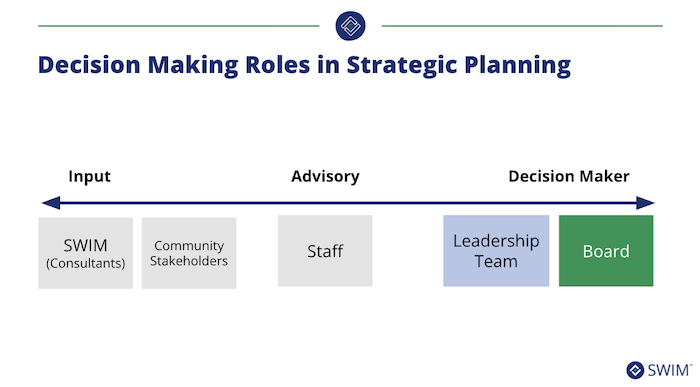
The decision-making spectrum during planning, where staff plays an advisory role and the board acts as decision-makers
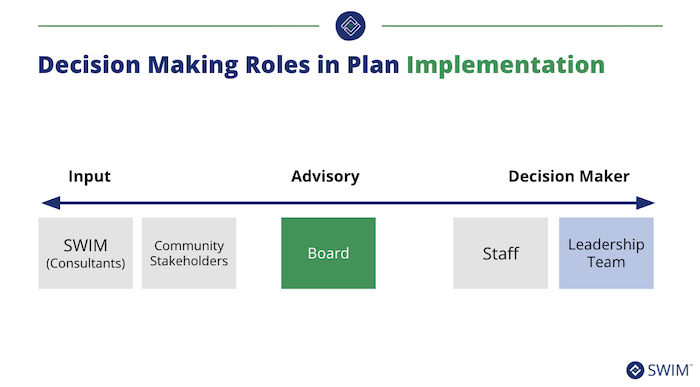
The board and staff swap roles in the implementation phase, when the plan is being carried out
Organize your stakeholders – staff, the leadership team, the board, community members, and your consultant, if using one – into three decision-making roles: input, advisory, and decision-maker.
Explain these roles to all stakeholders at the beginning of planning to avoid any power struggles, confusion, or frustration. We find that having a clear conversation up front shows respect for everyone’s place at the table for years to come.
Related article: How Funders and Nonprofits Can Build Better Relationships: An Open Dialogue
8 Elements to Include in Your Nonprofit’s Strategic Plan
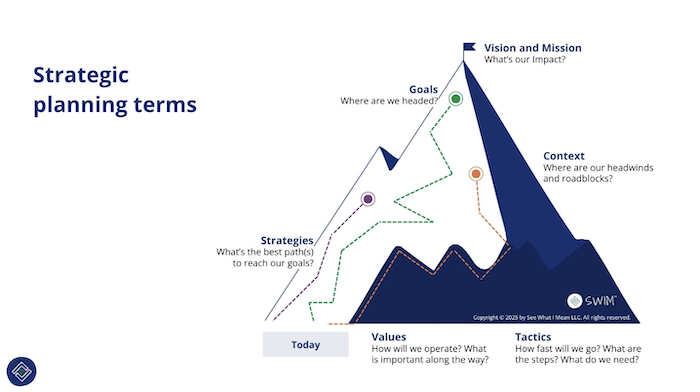
Our strategic planning model includes these elements. Use it as a nonprofit strategic plan template for your organization.
1. Plan Title
The title of your plan should give a sense of the direction or theme for the next chapter of your organization. This isn't something that's going to change a month after you implement it. The title should remind you, at any point over the next 3-5 years, what the ultimate goal is for your organization.
Examples:
THRIVE (Northern Illinois Food Bank)
A Force for Equity. A Funder for Change. (Chicago Foundation for Women)
Deeping Our Impact. Building Lasting Solutions. (Greater Pittsburgh Community Food Bank)
2. Mission and Vision
Mission and vision statements articulate the world you want to create. They put words to your desired impact and how your organization can achieve this impact, and they’re typically in place for 10+ years.
You likely already have a mission statement for your nonprofit. Some organizations reimagine it at the strategic planning phase, and others keep it the same.
Examples:
Vision: A world where…
Mission statement: We achieve X by doing Y.
“With SWIM’s guidance our annual strategic planning meeting went smoothly. Not only were we able to work through some heavy topics but we did it by using fun and dynamic tools that Stacy put together for us. These tools allowed all the voices in the room to be heard and I believe we were able to develop a more robust plan because of it.”
—Jennifer Banta, former strategic planning client
3. Values
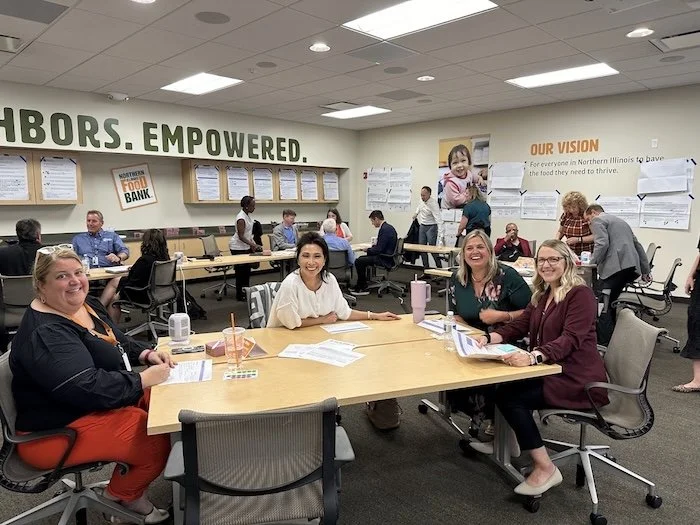
Values are a list of commitments that guide your culture, actions, and decisions. These will ideally be in place for 10+ years, so they should be evergreen core values.
Examples:
Innovation
Transparency
Equity
Humility
Anti-racist
4. Goals
The goals section of your strategic plan covers 3-5 strategic goals you want to achieve in 3-5 years.
To avoid planning overwhelm, know this: You don’t have to start from scratch!
Take stock of your progress toward your current goals and the particular moment or context you are in. Survey the needs of different stakeholders by asking them directly and by understanding internal and community data. (And to honor the voices you’re listening to, always share the data back with those who provided it.)
With all of this understanding in mind, you’ll be able to see:
What goals might need adjusting
What goals you can remove
How you need to shift or add new goals
5. Strategies
Your strategies section breaks down each goal with 2-3 ways to reach that goal, based on your strengths as an organization and the landscape in front of you.
A strong planning process will gather information from an array of people, and differing perspectives will emerge on what the most important strategic priorities are. This is where you’ll refer back to your decision-making roles you established at the beginning. Remind your stakeholders of their role in the process and who will make the final decision after all voices are heard.
Related article: 5 Ways to Use Your Strategic Plan Every Day
6. Tactics and Actions

The tactics and actions section outlines annual activities to advance your strategies in order to meet your goals.
If you have multiple teams, each team should have their own action plan. You might also split up actions by staff members to harness each individual’s strengths.
Shared Accountability is our favorite method to use week-by-week for carrying out tactics and actions. It’s a structured meeting format and a shared tracking sheet you can use to advance work that spans multiple teams.
The method prioritizes each individual’s expertise and mobilizes them with accountability to their commitments. See how Shared Accountability is helping one community college forge strong relationships as they carry out their strategic plan.
7. Resourcing and Capacity
This section will likely be for internal use only. Write what it may take to implement the plan or limits to the growth that your nonprofit operations can sustain. This is typically formulated as 3-year guardrails or priority investments. The resourcing and capacity section can be used to make financial decisions during annual budgeting.
Examples:
Reserve funds remain at X months.
FTE count will rise faster than contributions in the first two years.
Free Download: 9 Questions to Optimize Your Strategic Planning
8. Metrics and Targets
Metrics and targets are the numbers and data that will help your team (and your greater community) see your progress. This is often what’s shared with your nonprofit board members and any other key stakeholders, and in annual reports.
Targets are typically annual: They’re a measurement of how much progress you want to make in a year.
Metrics are key performance indicators (KPIs) for the entire length of the plan (3-5 years).
Pro tip: Map each metric onto a strategic goal so everything you’re measuring has a purpose.
Examples:
Metric: Growth in major donors.
Target: Increase from X to Y.
2 Sample Strategic Plans for Nonprofit Organizations
These nonprofit strategic plan examples will help you see what this can look like in real life. As strategic planning consultants, we helped these organizations:
Review and analyze existing data to inform their strategy
Facilitate meaningful community engagement and conversations
Run staff and board retreats to explore and refine their goals
Develop their metrics, tactics, and timelines for successful implementation
Northern Illinois Food Bank: Strategic Plan THRIVE (2026-2030)
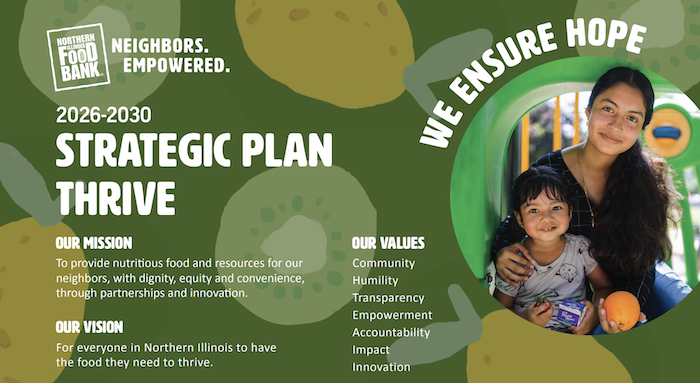
Our mission:
To provide nutritious food and resources for our neighbors, with dignity, equity and convenience, through partnerships and innovation.
Our vision:
For everyone in Northern Illinois to have the food they need to thrive.
Our values:
Community
Humility
Transparency
Empowerment
Accountability
Impact
Innovation
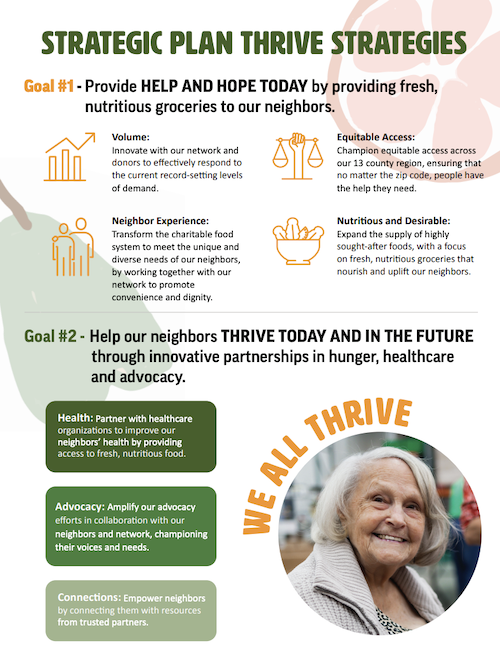
Goals:
Goal #1: Provide HELP AND HOPE TODAY by providing fresh, nutritious groceries
to our neighbors.
Goal #2: Help our neighbors THRIVE TODAY AND IN THE FUTURE through innovative
partnerships in hunger, healthcare and advocacy.
Goal #3: EVOLVE the Food Bank to meet the needs of 2030.
How we’ll measure our progress:
Provide 450M meals
Ensure that 75% of food purchases meet high nutritional standards
30M visits to our agency partners and programs
Invest more than $200M in our neighbors and communities
Our commitment to our neighbors:
Provide fresh, nutritious food for 1 in 10 neighbors in Northern Illinois.
Accelerate equity by increasing meals and improving access in more than 80 priority underserved communities.
Our Food Bank and agencies are making a difference with 80% of our neighbors reporting a positive experience.
Triple the number of people served annually through health and benefit partnerships.
See the full strategic plan here.
Filantropía Puerto Rico (2023-2027)
Vision:
A Puerto Rico with equal opportunities to participate and prosper available for all.
Mission and values:
Develop philanthropy and strategic social investment in Puerto Rico to promote equity and justice that develops equal opportunities.
Goals:
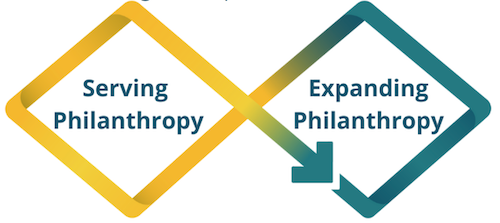
Serving Philanthropy: Support philanthropic organizations in adoption of philanthropic practices that advance equity in Puerto Rico. Enable foundations to use their resources more effectively.
Expanding Philanthropy: Expand philanthropic resources to advance equity in Puerto Rico. How we support in generating money and other resources for the field/ecosystem.
Sustainable + Joyful Operations: Establish and maintain a financially sustainable and joyful operational structure that empowers the organization to successfully attain its goals, while cultivating an atmosphere of happiness and well-being.
Filantropía has made progress on these goals year after year. Their 2024 Impact Report dashboard is a fantastic example of how to share your milestones publicly.
“SWIM stepped in with their expertise and provided invaluable support in facilitating our strategic planning sessions and collecting input from our members. Thanks to Stacy's assistance, we were able to make informed decisions that reflected the collective diversity and wisdom of our membership.”
—Glenisse Pagán, Executive Director, Filantropía Puerto Rico
Read Filantropía’s post on the strategic planning process with SWIM to get a feel for how we put this plan together.
Get Help With Your Strategic Plan
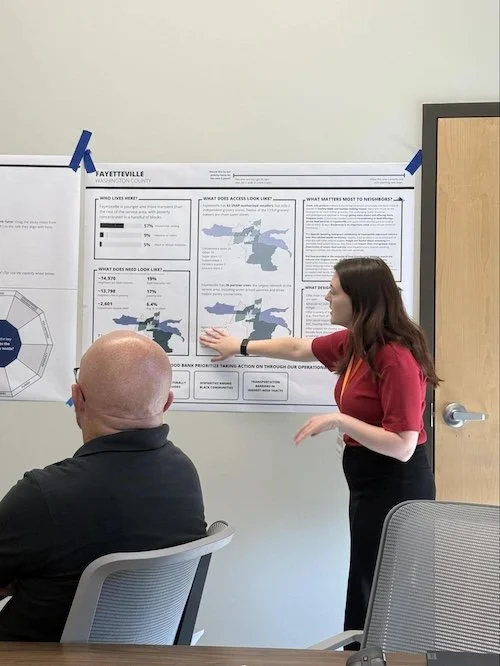
SWIM facilitator and data specialist Jenna Hoover shares focus group data and neighbor insights with Northwest Arkansas Food Bank.
See What I Mean is made up of strategic planning consultants who love to accelerate the progress of organizations changing the world. We work with nonprofits of all sizes and types, from food banks to youth advocacy to health care to philanthropic organizations.
“Having a game plan ahead of time was reassuring for us and our board. The structure, along with the flexibility to adapt, made it feel like this was truly a process for us, with us.”
—Sarah Helleso, Executive Director, Try Pie
Get an actionable strategic plan and implementation roadmap that result in clear, bold commitments your staff, board, and community can rally around. Read more about our strategic planning services or schedule a time to connect with SWIM today.