
Our Food Security Ethos at SWIM: 6 Values That Guide Our Consulting Work
By: Jordan Vernoy
I was in a legislative committee hearing when a food bank funding bill I had worked on for two years almost died. It wasn’t the usual suspect of a legislator not approving the bill. It was because a fellow food security organization had issues with the legislation they hadn’t shared with me that they decided to share in the committee hearing. I sat there watching people who genuinely cared about neighbors facing hunger sabotage themselves over a disagreement they never even had a chance to discuss with one another.
“We're not talking about this if you all are infighting,” the head of the committee said. We had to stop the hearing and take valuable time to make sure we were all on the same team.
This moment has stuck with me. Although we in this field care deeply about getting food on people’s tables, we can get caught up in getting things done a certain way and forget the neighbors at the heart of our work.
And I get it. After 20 years working in food security at Feeding America, alongside food banks in dozens of states, and now at SWIM, there have been plenty of things I’ve had to unlearn.
It’s helped me develop a strong ethos of food security work that’s woven into SWIM’s fabric.
Our Food Security Ethos at SWIM: 6 Guiding Values
When we work with food banks across the U.S., we center on these 6 core values as the foundation of our consulting work.
1. Food is a human right
I was asked about my philosophy on food security recently, and this was the first belief I shared. Food is a human right. Everyone deserves to have access to food, ideally healthy, nutritious food that’s culturally relevant to each person. As SWIM’s Food as Medicine expert Amy Haynes says, "Access to nutritious food is inseparable from the mission of ending hunger.”
Food is a human right even if we hold very different beliefs than the people we're serving. If we’re willing to fight for food for people we align with, we must also be willing to fight for people whose beliefs we vehemently disagree with.
Recently I engaged with some neighbors who were pretty clearly white supremacists. It challenged me to really examine this core value: Do I really believe food is a human right for people whose beliefs I find abhorrent?
The internal conversation that ensued was a long and hard one, but where I landed was “human right” means all humans, so the answer was yes.
2. Always ask, “Who are we missing?”
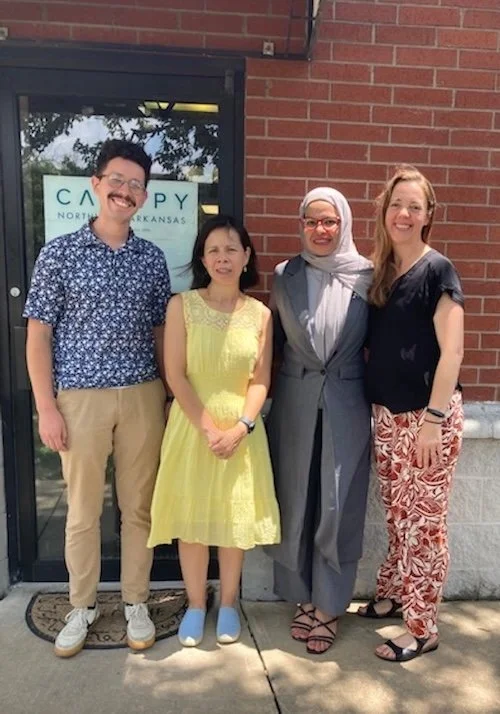
SWIM Consultant Amy Haynes visits Canopy of Northwest Arkansas, a refugee resettlement organization, to facilitate a focus group.
Throughout our research for food banks, which includes combing through publicly available data and Feeding America’s Map the Meal Gap, we pay attention to whose voices are missing and why.
A food pantry can have shelves full of food to support people, but there’s almost always a pretty big group who don’t have equal access to it. Maybe it’s too far without a car, or the hours don’t align with their work schedule, or it doesn’t offer food that’s relevant to their culture or diet. It could also be that the traditional models and organizations that do this work don’t have the trust needed to offer assistance to people in very vulnerable situations.
Our work centers around finding those pockets of populations who can’t or won’t access food pantries in their area, and helping food banks to understand how to serve them differently.
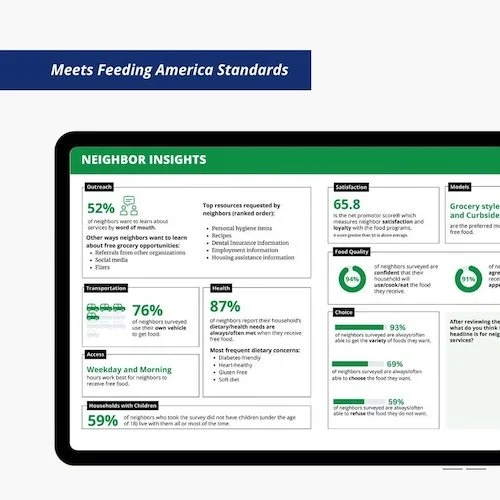
A sample Neighbor Engagement report we delivered to a food bank. Among the insights on the page are: “52% of neighbors want to learn about services by word of mouth.” / “Weekday and Morning hours work best for neighbors to receive free food.” / “Top resources requested by neighbors: Personal hygiene items, recipes, dental insurance information, employment information, housing assistance information.”
3. Data doesn’t tell the whole story
Our data expert Jenna Hoover reminds our clients that we should never rely on numbers alone, because numbers don't tell us the full story. Data is created by people who have the power to create it.
There have been points in our history where government programs are running really well and food banks are working only on addressing emergency needs. During those periods, if you looked at distribution numbers and lined them up with the number of food insecure individuals, it would look like everyone should have their needs met. But working in community at that time, we could still see scores of people who were food insecure, but weren’t being counted by the data.
We had to look beyond the numbers in front of us and talk to the people around us to truly understand what they needed.
In our current food insecurity landscape, our government systems are more unstable than ever:
A major dataset like the Household Food Security Survey from the USDA has stopped being collected at all.
People facing hunger are used as a bargaining chip at the administration’s whim, like we saw in Minnesota in the winter of 2025/2026.
People can be eligible for SNAP but not accessing it, especially in states like Arkansas where the program has been so heavily stigmatized by state leaders.
In fact, in our current environment, the gap between the meals a family needs and what government and charitable food can provide is growing at an alarming rate.
When the gap appears to be met on paper, we know certain families still lack access, and others only have the food they need because of programs like SNAP and food pantries. Those individuals may be considered food secure by the USDA standards, but if a family must lean on unstable government assistance and the generosity of their neighbors to feed their family, we believe they are not food secure. Contextualizing the data we do have (and finding who might be missing from it) is complex, important work so we can see beneath the numbers to the faces, voices, and stories of the neighbors around us.
4. Listen to neighbors and give them the power
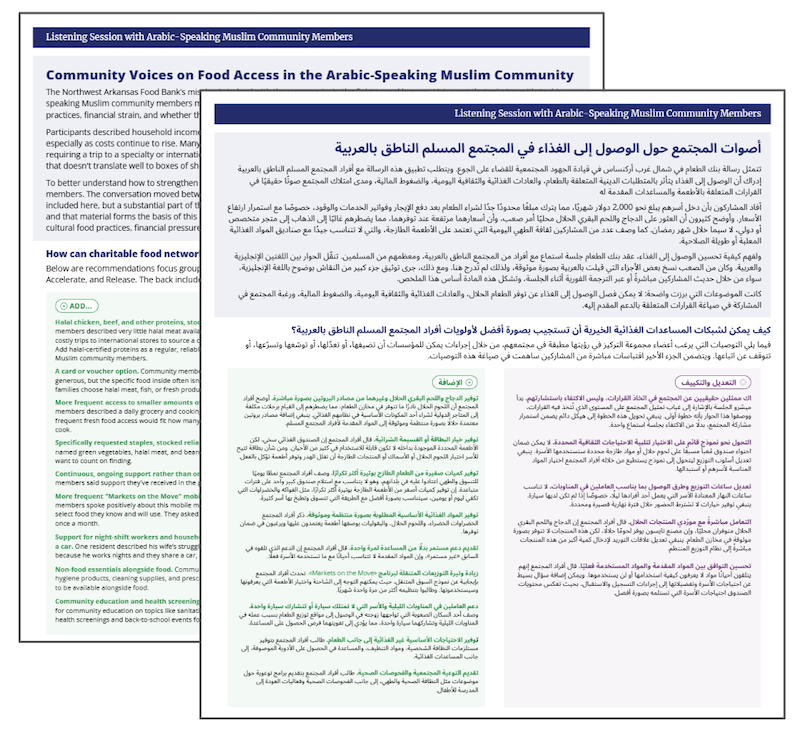
After a focus group with Arabic-speaking Muslim community members, we shared a summary of our learnings in both English and Arabic so participants had equal access to the information.
Our ethos also centers around listening to neighbors (the people accessing food banks) to inform and shape decisions regarding things like open hours, type of food served, services offered.
Because food pantries are often run by white, middle-class volunteers, the programs can be designed for people like them, not the communities they serve. We encourage our clients to address this by talking to neighbors facing food insecurity and implementing what they share.
To honor the voices we’re listening to, we always share the data back with those who provided it.
When people don’t hear or see how their input led to action, they reasonably assume it didn’t matter. The change might happen, but if the feedback loop is slow or unclear, the perception becomes that nothing changed at all. For that reason, we ideally ask participants to help prioritize what comes next for changes at their food pantry.
5. Leverage trust instead of building it from scratch
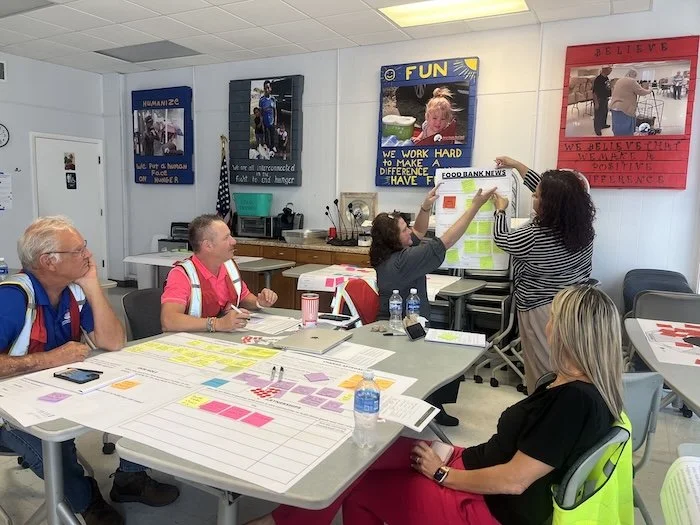
SWIM visits Harry Chapin Food Bank for an operational planning session to collaborate on how to address access challenges that neighbors brought up in focus groups.
Our Neighbor Engagement work comes from a place of meeting neighbors where they are, not asking them to come to us. We lean on existing community infrastructure and trusted leaders in communities to find folks to participate in listening sessions or focus groups, because there’s already trust there.
Lots of food banks might like to hear from their local Afghan community, for example, but they aren’t sure how to start the conversation and they aren’t showing up in surveys. Our approach would be to call the Afghan community center and ask, “Would you mind hosting a focus group around food security with your neighbors, and would you translate it?” Of course, we compensate both the neighbors and the Afghan Community Center for their efforts.
That’s a real example, and we got an enthusiastic yes. Non-food-bank organizations are more open to helping than one might think, and they might become part of your distribution network. You might learn that your Afghan neighbors want the food distributed right there at the community center. We’d recommend making that happen so you can leverage the trust that has been built up by local leaders.
6. We need each other
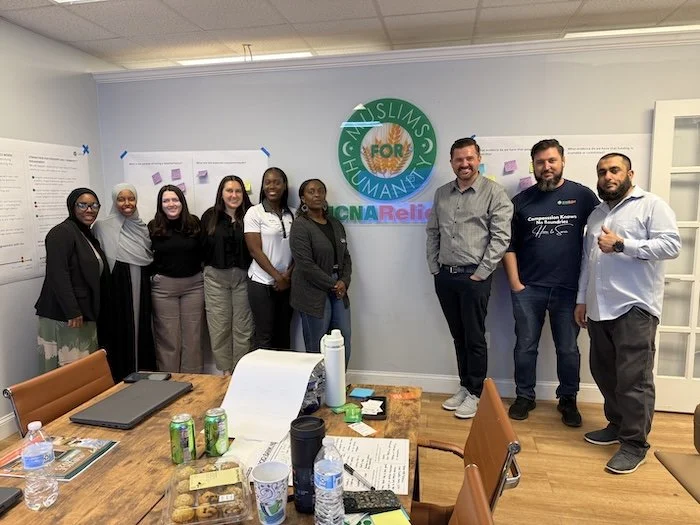
SWIM visits the Islamic Circle of North America Relief’s Georgia team and Atlanta Community Food Bank to talk about neighbor engagement through culturally appropriate food sourcing, satellite pantry expansion, and wraparound services.
I'll end with this: A key part of our ethos of food security at SWIM is that we need every willing partner in this work, at every scale. The mutual aid group that shows up for a family that is scared to leave their home. The church pantry that neighbors trust because they've known the volunteers for years. The food bank that moves millions of pounds and keeps the shelves stocked. The state association that coordinates across regions. The national organization that shapes policy and purchases food at a scale no local group ever could.
None of these can do the others' jobs. A national purchasing contract can't build trust in a rural community, and a grassroots group can't change federal SNAP policy on its own. Together, alongside grocery stores, health clinics, schools, government agencies, and other partners, we can reach neighbors no single organization could.
That only works if we do more than tolerate each other. It works when we lift each other up. When the national organization amplifies what it learns from the mutual aid group. When the food bank invests in the small pantry instead of measuring it against the large one. When grassroots groups bring neighbor voices into the policy conversations happening far from their neighborhoods.
When resources get tight, it's tempting to decide who matters most. We'd rather get the best out of each other before we write anyone off.
I wish I had seen that unity at that legislative hearing years ago. But the friction those leaders faced ended up fostering dialogue that led to a productive rest of the day. The bill was passed because the two groups were able to unite around their shared mission. When Governor Terry Branstad made the decision to veto the bill, we had a strong coalition ready to try again in the following legislative session, and we won!
If you share our food security ethos and want to partner with us to become more neighbor-centered, set up an introductory meeting with our food bank consultants today.

Jordan Vernoy, CNP, is a network engagement nerd. His tenure in the Feeding America network concentrated on challenging people to think differently about the work of ending hunger in America. Networks can realize their vision by focusing on the people facing the issue, understanding the value each member of the network holds, and maximizing those resources to have the biggest impact. He works with organizations and companies to embrace practices for deepening engagement. Jordan holds a master’s in nonprofit management and is a Certified Nonprofit Professional.