
Budget Your Influence: How to Invest Your Impact and See It Grow
By: Stacy Van Gorp, Ph.D.

The idea of using your influence can feel deeply uncomfortable for some leaders, like shoes that are too tight. It might conjure up an image of a person who calls all the shots, tramples on less-powerful people, or wields authority to keep themselves on top.
That’s not the kind of influence (or the use of influence) we’re writing about today. SWIM’s take is that influence and authority are different.
Authority is about the responsibilities you’re obligated to undertake or the decisions you’re expected to make, given your title or role. But influence is about how you inspire, encourage, and nudge others to act in new ways. It’s usually based on the relationships you’ve formed, the expertise you carry, and the proximity you have.
We think about influence as a sense of awareness around the dynamics at play, so you can calibrate how you show up for the good of the cause. As you build that awareness, you’ll hear an inner voice calculating whether it’ll be worth it to use your influence in a given situation.
You can plan for how to use your influence even when you have no official rank, position, or title. And if you’re a funder or a person with lots of authority (let’s call it what we mean – power), we’ll give some tips on how you might “spend” that influence to make space and amplify others.
When you lead with influence instead of authority, you can engage people in a way that creates movement toward your goals. Influence is relational. You can't be influential without other people. In an authority structure or culture, power and influence are often one and the same. In an accountability-based network or values-driven organization, you can most authentically grow your influence by deepening trust.
We’ll show you how to use your influence intentionally – in alignment with your values and goals – in three ways: your budget, your tools, and your roles.
Your Budget: How Will You Spend Your Influence?
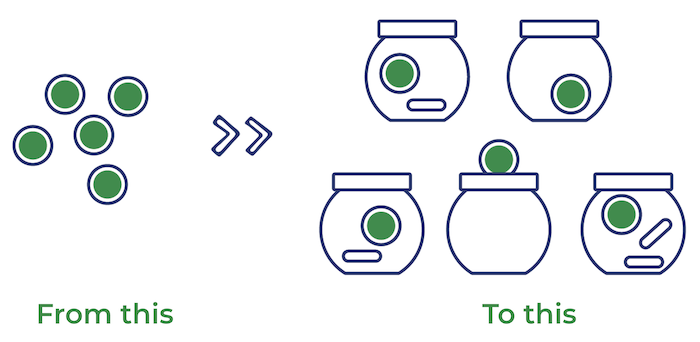
For most of us, influence isn’t unlimited. How might you best spend it?
We run an exercise with our clients (which span nonprofit leaders, community organizations, and funders) to illustrate the concept of “spending” your influence.
Imagine your team has scheduled a meeting to brainstorm next year’s strategic plan. You want the group to support your innovative idea that seems perfectly aligned with your organization’s goals. It’s a moment that you want to influence others.
You have 100 total influence points to use in the meeting. At each of these moments, decide how many influence points you’ll spend, if any:
An agenda comes out before the meeting, and the item you want to discuss isn't included.
You asked for your item to be added before the meeting, but you get there and it's still not on it.
The group is working on a commitment statement, and you think a word could be seen as demeaning or offensive.
The group is prioritizing projects, and the most innovative ones – including yours – land at the bottom.
A break comes up on the agenda and you'd like to take one, but everyone else wants to push through.
Someone makes a false statement about a topic where you are not seen as the expert.
Someone makes a false statement about a topic where you are seen as the expert.
A person with less authority than you makes an important point that gets swept away by a dominant person who is taking more than their fair share of airtime.
In the final moments, you have the opportunity to make a statement that could have a big impact on your idea's future – but it will cost at least 50 points to land.
When we run this exercise, we see two strategies:
Many people have fewer than 50 points left by the time they reach #9. A lot of folks use up a large chunk of their budget on the first two moments alone to get their idea onto the agenda.
Others hold onto their influence chips for the entire meeting, walking out the door having saved it all for an undetermined future moment.
Where did the majority of your points go?
Guiding the agenda (items 1 and 2)
Aligning the group with its values (item 3)
Embracing humanity (item 5)
Stewarding facts and accuracy (items 6 and 7)
Advancing your point of view (item 4)
Giving away your influence (item 8)
Saving up for the big moment (item 9)
Does how you typically spend your points differ from how you want to spend your points in the future?
Maybe you spent so much energy shaping the agenda that you want to be the one writing the agenda so you can focus on listening and synthesizing in your next meeting.
Maybe you found yourself hoarding your points and ending the meeting with 50 or more points leftover. Perhaps you don’t believe anyone will listen to you, maybe because you’ve been shot down one too many times.
Put it into action: After your next meeting, analyze how you spent your influence. Take note of themes so you’re aware of your default settings.
Your Tools: Get the Most Out of Each Point You Spend
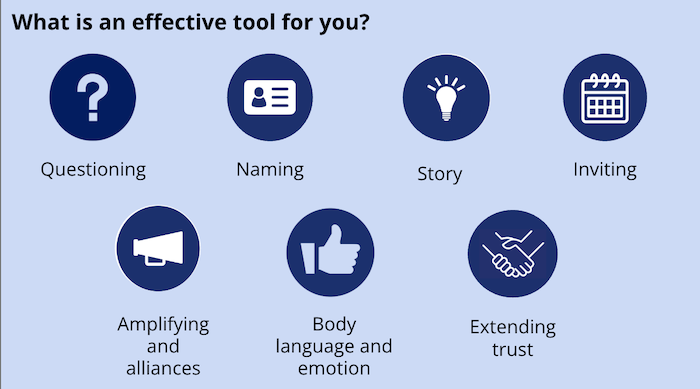
The right tool depends on the room, the moment, and what's at stake.
Once you’ve studied your budget, the next question is which tool gets you the most out of each point you spend.
If you’re not in the C-suite or you don’t hold any power in the room, these tools will help you build your influence. And if you have lots of influence points, perhaps as a grantmaker, these tools will help you expand the table rather than just getting your way.
Here are two vital tools for your influence toolkit:
Questioning: Get curious about ideas you disagree with rather than being hostile. Divisive exchanges can cost you influence. Of course, you can disagree with an idea, but instead of shutting it down immediately, invite conversation with a question like: "That's an interesting idea – can you help me understand how it gets us to our core cause?"
Amplifying and alliances: Sometimes people aren’t listened to as much because of tenure, role, race, gender, age, or a dozen other factors. They have to work harder for their influence to make change. You can spend your influence (and maybe gain more) by providing a “plus-one” to someone else in the room. Amplifying can sound as simple as: "I love what I heard (name) said about centering the people most impacted by this issue – who has ideas for how we implement that?" or "Let's circle back to what (name) raised at the start of the meeting. I think she was onto something."
Other important tools are:
Naming: Making explicit (with words or pictures) what other people are implying or what is going unstated can help clarify and often galvanize the group.
Story: Tell a story to counter an argument. This can sound like: “I hear that you think this initiative is too expensive. I want to share a story about Sam, a client I met last week.”
Inviting: Ask someone else to share a response, an opinion, an idea, or a question.
Body language and emotion: Take stock of how you’re sitting, where you’re sitting, what you’re doing with your hands and body, and how much you’re expressing emotions (or not).
Extending trust: Extend trust through listening, respecting others’ expertise, and honoring their decision-making power and agency. This could sound like: “I believe that our client council has the most expertise on this issue. I trust their input. Let’s pause and ask.”
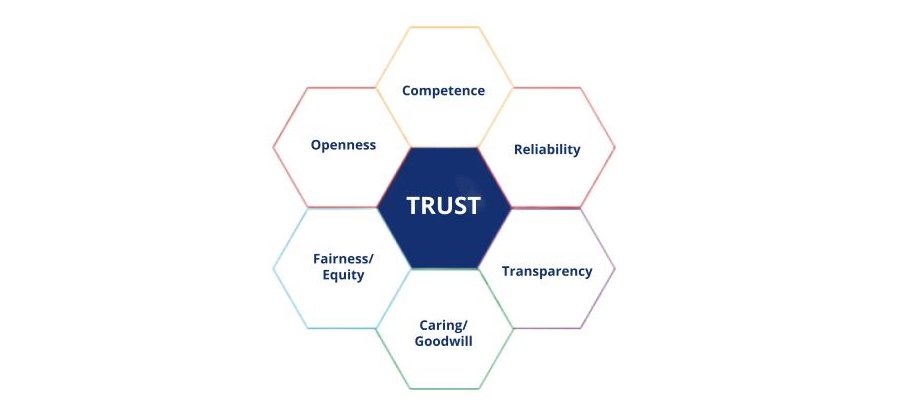
You can most authentically grow your influence by deepening trust through six variables: Openness, competence, reliability, transparency, caring/goodwill, and fairness/equity
Put it into action: Pick one new-to-you tool to use in your next meeting.
Your Roles: Know When to Give Away Your Influence
Influence is shaped by the role you play in a group.
Some roles are formal and reflect our authority, like Chair, Head of HR, or Administrative Assistant. They convey your level of responsibility without you saying a thing.
Others are informal roles (we call them “little R” roles) built from your strengths and reputation rather than your position. You might be known as “the devil’s advocate” or “the big-picture thinker.” You might be known for always bringing up budgetary concerns or having an eye on the clock.
Both kinds of roles shape how much influence you start a meeting with and what people expect of you when you use it.
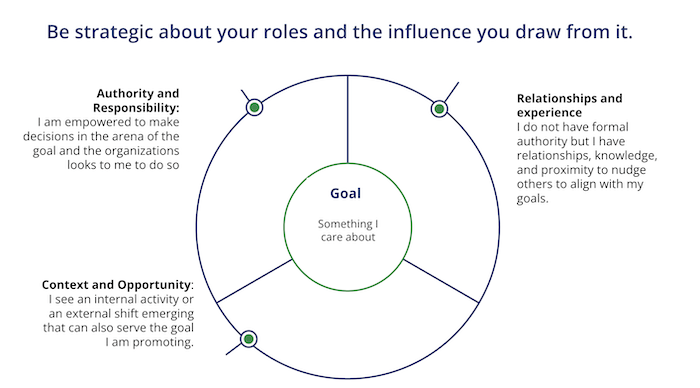
If you’re lacking in one area of influence, you can draw from another to achieve your goal.
If there is a typical “little R” role you tend to play in meetings, stepping into a different one can cost or grow your influence. We worked with a network leader who was known for her energy. Her engaging nature is part of what earned her a seat at so many tables. But she felt boxed into being “the fun one” and worried that if she switched roles too suddenly, it might cost her the influence she built.
It can help to verbalize the switch-up: “I’m going to try something different today and pump the brakes on this proposal.” “I’m excited about the ideas others are bringing forward and am hoping to play a listening role today.”
We also want to note that in this exercise, we all came to the situation with the same budget. But a more accurate starting point would have been to give more points to the person in the room who holds the most power, and give a smaller number to newcomers or people with less privileged identities. For some people, no matter what they say, their ideas will be listened to less.
This imbalance shows up everywhere, and there's a well-documented example from the Obama White House: Women on staff noticed they were consistently outnumbered by male colleagues who often claimed credit for their ideas. So they banded together with an amplification strategy – when one woman made a key point, the others in the room would repeat it and credit her by name. Over time, this trained the room to recognize both the contribution and its source.
It’s imperative that network leaders work to address this imbalance. Those who start with a larger budget due to power or privilege can lend their influence to people who have important experiences to share but less influence.
You can lend influence by:
Redirecting conversations
Waiting to speak
Deferring questions to others
Amplifying what someone said
Put it into action: Think about the roles you play, both informal and formal. Where could you loan your influence to advance equity?
Spend on Purpose
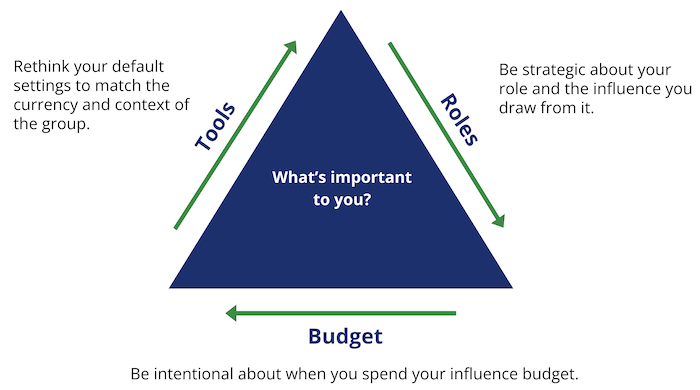
Influence is a resource. It’s easy to spend without noticing. It’s renewable – but only with great care – and unevenly distributed. The goal is to spend it on purpose. Know your budget, know your tools, and know which role you’re playing and what it’s earning you.
If you have more influence than other people in the room, use some of it to make room for others.
We’d love to run this exercise with your team, board, or coalition. Schedule a free discovery call with SWIM to talk through what it could look like for your organization.

Stacy Van Gorp, Ph.D. is a self-described organizational strategy and innovation nerd. Stacy's decades providing consulting services in strategic planning, innovation, research, and program design are rooted in her experiences leading a private foundation and her work in higher education, nonprofit leadership, fundraising and youth services. Her passion is helping leaders cut through complexity to illuminate opportunities. Her research interest centers around the role of trust in accelerating innovation. Stacy is recognized for her expertise in developing actionable models for change within institutions that serve a public good.
Her mission is to connect the people, resources, and ideas to change the world. See What I Mean is the manifestation of that mission.