
How Food Banks Can Rethink Segmentation in 2026

As a food bank leader, you feel a responsibility to support your partner agencies in having the capacity needed to create dignified access to food for neighbors. You also want to distribute your resources effectively and efficiently.
But how can you do it more equitably?
For a long time, food banks have used segmentation, specifically the practice of tiering. It meant prioritizing partners who could demonstrate volume and capacity, a logical place to start when the goal was moving more pounds. It also had the unintended consequence of making the existing inequities worse.
There’s a “new” type of segmentation that addresses the issues of the old tiering system while helping you sort your agencies into helpful groups that get targeted types of support. At SWIM, we think it's a meaningful shift, and food banks are putting it into practice. Here’s what it looks like.
The Historic Practice of Tiering
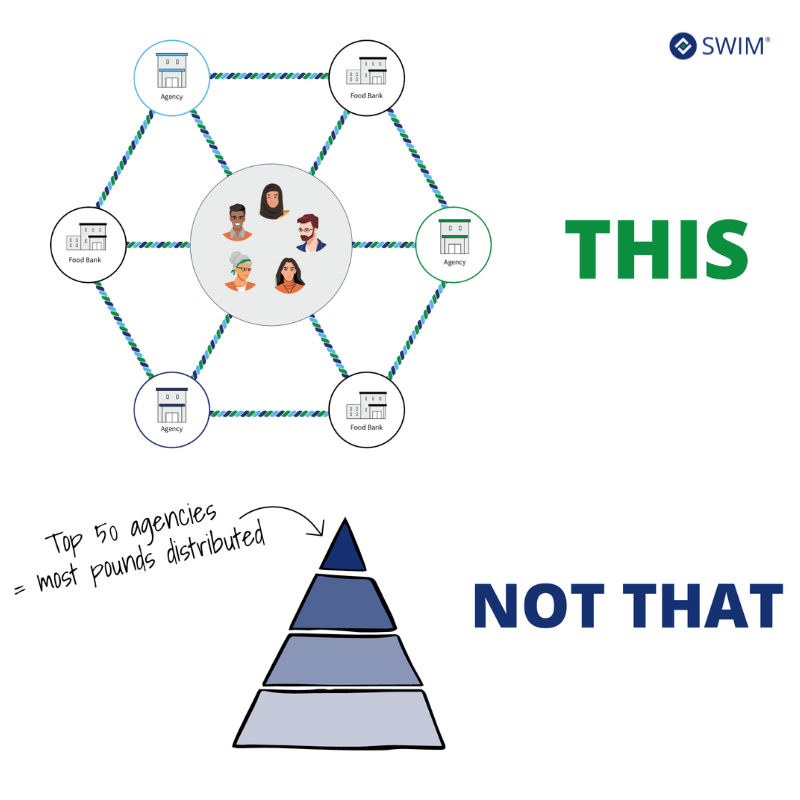
From the mid-2000s on, many food banks used a tiering model to categorize their agency partners. Tiering was a practice of identifying the highest-performing agencies in terms of pounds distributed, hours of operation, and positive engagement with the food bank; and giving them preferential access to food, funding, and support. High-volume, well-resourced organizations floated to the top tiers.
The problem was that "high-performing" often meant "well-resourced to begin with." Agencies serving historically disenfranchised, redlined, and under-resourced communities ended up in lower tiers based on the criteria utilized. Moving up often required resources, staff capacity, or grant-writing ability that these agencies simply didn't have. A Tier 3 agency might need to extend hours or increase distribution to move up. But without additional funding or staff, that wasn't realistic. The criteria for advancement assumed resources the agency didn't have. Agencies were put into a box they couldn’t get out of.
Some agencies were kicked out of networks entirely. In some cases, agencies that had served their communities for decades, often before the food bank existed, suddenly lost access to the food system because they couldn't meet criteria designed for much larger organizations. That created real harm, and in some regions real conflict, that the field is still reckoning with. The unintended result was that inequities within food insecurity deepened. Communities that needed the most investment often received the least.
The good news is that the field learned from this. What's replacing tiering is something more useful and equitable.
Strengths in Every Agency
We've worked with food banks across the country to develop a new segmentation approach. Food banks still want to do segmentation to be strategic about their work, but not in a way that ranks their partner agencies.
Think of how brands segment their audiences for marketing purposes. An audience is a specific group of people most likely to buy a product. Brands segment their audience based on age, gender, income levels, values, interests, geographics, and online habits. Having these audiences helps the brand tailor their messaging and make sure their time and budget is aimed at the most receptive customers.
Like the segments of an orange, segmentation splits your “audience” (agencies) into different groups, all on the same level, so you can tailor your support to each one.
Just as a brand doesn't put a customer in one box and leave them there, this approach recognizes that an agency's relationship to any given strategy will shift over time.
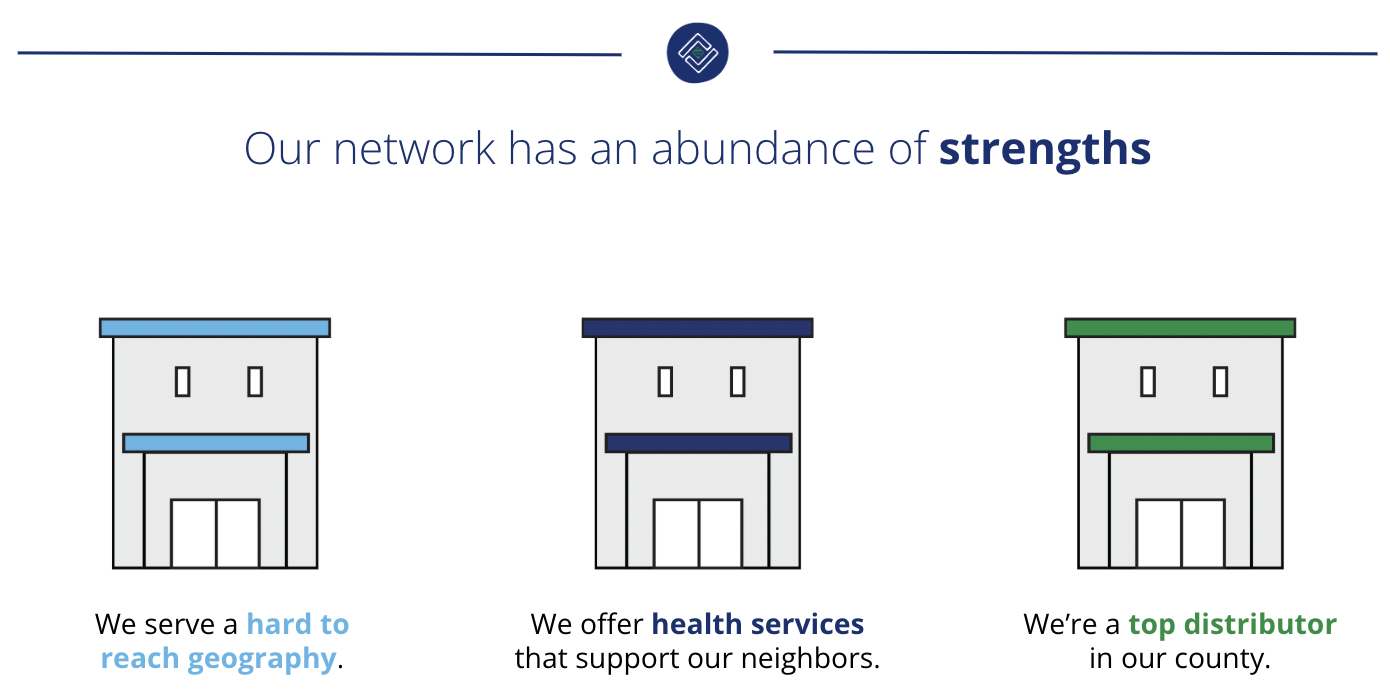
Our approach starts from the understanding that every agency has strengths. They each have a role to play in getting food to more neighbors. So instead of ranking and tiering, this equity-focused version of segmentation helps you direct support more strategically to each segment.
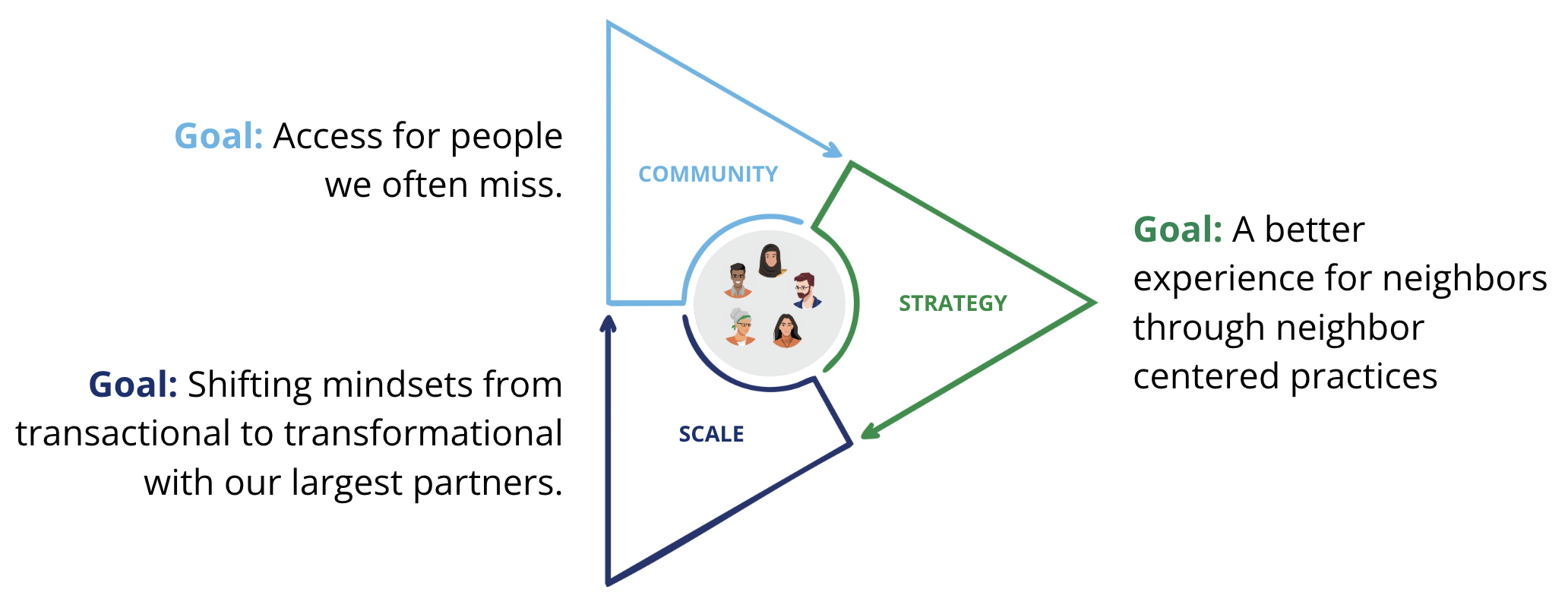
We help food banks organize agency partners by viewing strengths through three categories:
Community agencies are operating in under-resourced or systemically disenfranchised areas. They may be smaller. They may have less infrastructure. But they're often serving neighbors that no one else is reaching, and they have untapped capacity that the old tier system never unlocked.
Scale agencies have high distribution volume and/or significant operational reach. Their challenge is often logistics. They need support managing the complexity of moving large amounts of food effectively. They might not make a list of top distributors across partners, but they may be an instrumental distribution hub for a more rural community.
Strategy agencies are deeply aligned with neighbor-centered practices like choice pantry models, culturally responsive sourcing, wraparound services, and dignity-first design. These agencies show interest in aligning with the food bank’s strategic goals and are ripe for collaboration.
These segmentation categories don’t act as a ladder and they aren't fixed assignments. When a food bank decides what it wants to move forward, say expanding home delivery or reaching a specific community, it uses the three lenses to build a targeted list of agencies best positioned to help with that strategy. The same agency might show up on different lists depending on the goal. The lenses stay constant. The segment changes with the strategy.
The categories are tools for understanding what kind of support is needed, rather than if support is needed or deserved.
Critically, the data behind each segment comes from what agencies told you, through SWIM’s Network Assessment, ordering history, publicly available data and direct conversations, not from judgments the food bank made about them. That's a meaningful departure from how tiering worked.
Bringing These Segments to Life
In our SWIM Network Assessments across the country, a consistent finding has surprised food bank leaders: at least 80% of partner agencies are ready or willing to serve more neighbors, either immediately or with some support.
Under the old tier system, only about 20% of agencies were in the top tier. The system measured outputs (pounds, hours, etc.) and ignored potential impact or unique community histories.
The reality is that for smaller food pantries to serve more neighbors, they need minimal investment. For some Community agencies, just $700 would help them effectively double their distribution. One agency told us they just needed a bigger cooler and some racking to start handling produce. That's it. For a Scale agency in a large urban area, that money wouldn’t move the needle at all, but it could change the game for a small rural agency. Under the old tier model, that investment would never have happened. Resources flowed toward agencies already providing high volume, not toward agencies with untapped potential in under-resourced places.
This is one of the arguments for segmentation that I find most compelling. When you assume that bigger agencies deserve all your resources and attention, you forget about the strengths of agencies in communities that have faced centuries of discrimination and disinvestment and still show up for their neighbors.
Transparency Makes It Work
None of this works without honest communication. The agencies in your network need to understand how the segmentation process works, what it means for them, and how they can provide input.
The Idaho Foodbank offers a model here. When they undertook their segmentation work, they were open with agency partners from the start about the process, the criteria, and the rationale. Agencies could see what was happening and why. That transparency built trust in a process that, in a less open system, could easily have felt like the old tiering system.
Part of what made that transparency work is that agencies could see the data behind their segment reflected what they had shared. The segment wasn't a judgment. It was an interpretation of what they told you, and they could push back if it didn't feel right.
Segmentation is only equitable if it's legible. Agencies should know which segments they're in, understand what support that unlocks, and have a way to engage with the process rather than just receive its results.
Transparency also means embedding an opt-in mechanism. Agencies identified for a segment get a direct invitation. Agencies not on the list who want to participate can raise their hand. The data is a starting point, not a gate.
Support for All Segments
When this model is working, strategies get matched to the right agencies, resources reach communities that were historically bypassed, and agencies opt in because they recognize themselves in the data. That's a different outcome than tiering ever produced, and it starts from a different premise: not which agencies have already proven themselves, but which agencies are ready to do more, and what do they need to get there?
If your food bank is thinking about how to structure support for your agency network, we'd love to talk through what segmentation could look like for your region. Schedule a discovery call with our team.
Jordan Vernoy, CNP, is a network engagement nerd. His tenure in the Feeding America network concentrated on challenging people to think differently about the work of ending hunger in America. Networks can realize their vision by focusing on the people facing the issue, understanding the value each member of the network holds, and maximizing those resources to have the biggest impact. He works with organizations and companies to embrace practices for deepening engagement. Jordan holds a master’s in nonprofit management and is a Certified Nonprofit Professional.
