
How One Food Bank Used Publicly Available Data to Update Their Service Model

Jury Paulson is the Director of Community Impact at Harvesters—The Community Food Network, which serves 27 counties in Kansas and Missouri.
At a food bank, data is everywhere. Neighbors served. Pounds distributed. Agencies served. Counties covered. Jury Paulson, Director of Community Impact at Harvesters—The Community Food Network, knows this better than most.
"We live and die by data," he said. "It's a massive logistical operation."
But there's a difference between the data you collect day-to-day and the wider picture of who you're actually serving — and who you're missing. When Harvesters partnered with SWIM to do a Service Area Assessment and Network Assessment across their 27-county region in Missouri and Kansas, Jury and his team got to step back and see that wider picture.
What they found changed how Harvesters works.
Seeing Who the Data Was Missing
Census data and publicly available datasets tell a lot of the story. But not all of it.
To start, SWIM guided Jury's team to a handful of datasets that would frame the picture: U.S. Census data, the American Community Survey, Feeding America’s Map the Meal Gap, and data on food insecurity and poverty from state and local governments. We identify areas with the highest levels of food insecurity, assess geographic and racial/ethnic disparities, and pinpoint counties where food distribution is disproportionately low.
We paired that with data from Harvesters and its network partners in their service area.
As Jury and the SWIM team worked through the data together, a question we kept at the forefront was: Who isn't showing up here? We discovered three specific populations who were underrepresented in the data, but very much present in the communities Harvesters serves:
African and Caribbean immigrants
Latino community members
Seniors
To fix this gap, Harvesters hosted focus groups with each of the three populations, asking them about their food preferences, what service models actually worked for them, and what barriers were keeping them from getting support.
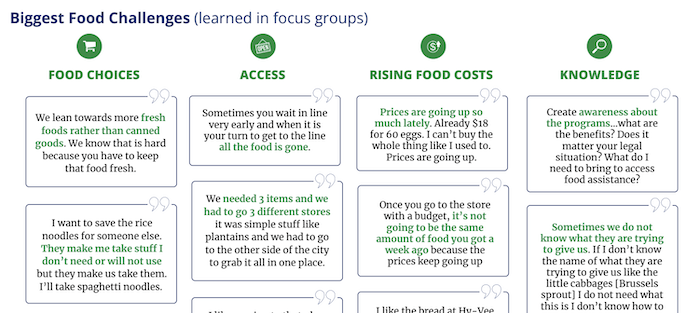
Focus group interviews with Latino communities in Harvesters’ service area revealed that they wanted more culturally relevant foods and choice in what foods they receive.
"When you include folks that are underrepresented in the data sets," Jury said, "that really turns the tide."
If a population wasn't showing up in public data, Harvesters wanted to make sure they were showing up in the organization's own planning and priorities.
Knowing When You Have Enough to Act
Jury is, by his own description, action-oriented. He doesn't want to sit on data. He wants to know what it means and move. But he shared a sentiment that all food bankers will relate to — there wasn’t enough time in the week to dedicate to this type of data-gathering.
“In the day to day, you're so busy, everyone's got their roles and assignments, and it's really hard to pull through what is important and what needs to be updated in your service models,” he said. “So the opportunity to have SWIM as a partner and look at census level data and beyond … really helped us see a different picture — the wider picture.”
He said that SWIM’s process helped them dive deeper and find novel opportunities to see who they were missing in their service models to improve delivery.
The turning point for Harvesters came when we delivered two overarching data streams: the publicly available census data and the results of the SWIM Network Assessment. The Network Assessment surveys agency partners, focusing on their assets, goals, and needs. When more than 300 of their agency partners responded to that survey, Jury had what he needed.
"We could take a look at what those agency priorities were, look at our service area from a new lens, and then combine those data sets," he said. "That changed the game."
The public data from the Service Area Assessment told Harvesters who was out there. The Network Assessment told them what their partners were positioned to do about it. Together, the two gave Jury and his team the confidence to act.
Turning Findings Into Momentum
Data doesn't create change on its own. People do.
When SWIM came to Kansas City to present the findings in person, Jury brought together a wide group of internal stakeholders — the people who would eventually need to carry the work forward. Together, they looked at the public data from the SWIM Service Area Assessment, the SWIM Network Assessment, and the focus group conversations with neighbors. And then they made decisions together.
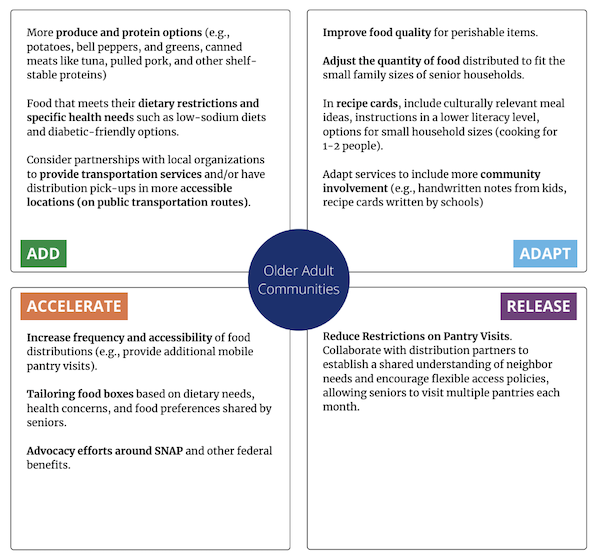
SWIM’s report for Harvesters shared how they could match the needs and desires of older adults living in lower-income housing.
"When you have collective buy-in, that changes the game," Jury said. "That gets people motivated to move forward and stick to the plan."
For Harvesters, the findings led to a closer look at where their service models — brick-and-mortar pantries, mobile distributions, senior food programs — were and weren't matching the needs of specific communities across their region. Meeting, missing, and matching: who were they reaching, who were they not, and where could the design shift?
That question is still guiding the work.
How to Use Public Data Well
Jury's experience at Harvesters offers a useful model. Getting there requires being honest about what public data can and can't do.
The first step is understanding a dataset's backstory before you use it. Why was it created? Who was included in it, and who wasn't? Many datasets include a "readme" tab with methodology and sourcing details. That's a good place to start.
You can also ask an AI tool to surface potential biases in a dataset before you begin any analysis. The goal isn't to disqualify public data, but to hold it accountable so you don't inadvertently reinforce the very inequities your organization is trying to address.
One concern raised by food bank leaders we talk to is the loss of the USDA Food and Nutrition Survey due to political shifts. This has left a real gap in food insecurity data. In its absence, organizations need to supplement public data with community-driven information — focus groups, surveys, direct conversations with neighbors — to avoid making assumptions about populations that aren't showing up in what remains.
When you're ready to move, we recommend these four steps:
Get clear on what you want to understand: Before opening a single dataset, define the question your organization is trying to answer and the decision you're hoping to make. That focus will save a lot of time.
Explore what already exists: There's more publicly available data than most organizations realize. Start there before creating new data collection processes.
Hold publicly available data accountable: If a data source can't tell you how it was collected, who was included, and who was left out, it may not be a reliable foundation for decisions.
Take action: Data is not the destination. Let it point you somewhere and move. As Jury put it: You tackle what you can, and you keep moving forward.
Curious what public data could reveal about your service area? Contact us to learn more about SWIM's Service Area Assessment.