7 Ways to Make Grant Applications More Equitable, From an Exhausted Grant Writer
By: Stacy Van Gorp, Ph.D.

After years working on both sides of the grantmaking system, I've noticed a very sad trend - many grants management systems are discouraging people from applying. That leaves some people - and their needs - invisible.
If I were to write an open letter to funders, this would be the crux:
There are people in your communities who have amazing ideas, incredible strategies, and exceptional commitment who you are not hearing from or investing in, because some of the processes foundations are using are cumbersome and exhausting. Even with the advantages of AI in editing and writing, the processes have too much friction.
The friction of your default settings may be creating a fault line in your community.
By the end of this article, you’ll have 7 tangible ways to fix that.
3 Problems With Most Grant Applications
Last year, our team was helping an innovative organization to seek grant funding to accelerate some big goals. I wasn’t surprised by the complexity in the federal grants management portals. That’s been long known.
But, among other kinds of funders - private, corporate, even community - we encountered so many systems that seemed designed to weed us out. We are experienced grantwriters and we were left frustrated and disappointed.
As funders, we must ask: Who might our grants management systems be leaving behind? What friction are we causing for strapped organizations? The majority of nonprofits don’t have a dedicated grant staff, so it’s not surprising that turnover in development departments is 16-18 months, according to the Stanford Social Innovation Review.
From my experience as both a grant writer and a funder, here are three challenges I see on the front end.
1. Fake Rules, No Answers
Many funders are using eligibility criteria well beyond what’s legally required. (The podcast Break Fake Rules is wholly focused on this topic!)
This can leave grantees, especially the most innovative among us, needing to know more, or wondering if we can check the boxes.
For example, let’s say a funder doesn’t fund organizations with budgets over $1 million. You work at a child abuse protection center that’s attached to a hospital system. You’re a small program in a big system, so your budget really isn’t $150 million, it’s $150,000. How do you explain that the system resources don’t flow in your direction? Are you eligible? Could you be?
What if you’re a startup with a fiscal sponsor - a practice that actually saves community resources? Does that count? Can you apply?
How about an innovator with an address in one place that wants to serve neighbors in another area?

Extensive grant applications with a mountain of questions can put a strain on the very fields grantmakers want to help.
Without some flexibility in your criteria and a real person to ask, you might be leaving behind your community's most creative and collaborative leaders who just can’t mark the boxes so easily.
2. Question Inflation
Recently, we reviewed a funder’s website. Thankfully, they provided a tidy list with four bullet points to tell us what we needed to gather to fill out the application.
However, we couldn't see the actual questions until we made it through the obstacle course of system sign-in. When we finally opened the application, there were at least 65 questions! (Honestly, I was so demoralized, I had to quit counting).
There were 42 questions before we were asked for project information, including 35+ questions about the organization, most of which were publicly available on the organization’s website.
While our team at See What I Mean can tackle this complexity on behalf of our clients, others in our community can’t devote the time to a mountain of questions. GrantStation reports that “writing grant applications took from two days to two weeks for 72% of respondents.”
Imagine a dedicated leader faced with 65+ funder questions, who is also faced with a crisis of affordable housing, food security, or climate change. Where do you want them to spend the next two weeks?
3. Filling Out Forms Isn’t a Good Test of Impact
It’s not just the number of questions that turn people away. It’s the complexity and the acronyms and tiny little character counts that can be a mismatch.
The skills it takes to traverse these applications - jumping through hoops, understanding jargon, and squeezing your idea into 150 characters - are not the same skills that make change in our community.
Instead, we need organizations that have the skills to listen to their neighbors, design a new offering with their clients, compel powerful collaboration, and paint a vision of change.
I’m pleased that community organizations can use AI to navigate this obstacle, but still, application systems may be producing the wrong measuring stick: judging the capacity of an organization to persist in the paperwork, but not necessarily to be effective in their community.
The Good News

I will say that the grantmaking world has made some significant improvements. Previously, I was CEO of a private foundation, so I know that these systems are not all bad.
Here’s the good news:
The switch to online grants management systems has removed significant stressors for applicants, such as whether the postal service will deliver their grant application before the due date.
AI is going to help people mold their answers to fit different application requirements. It can turn 472 words in one application into 75 words for the next.
The online systems provide super reports that used to take hours to manipulate manually in a spreadsheet.
Website communication for foundation purposes has improved greatly over the last few years, and online information can be more equitable - if we’re sharing all of the information.
7 Ways to Make Grant Applications More Equitable
We discussed the topic of burdensome grant applications one day in our See What I Mean team chat, and my colleague Kerry McHugh said this:
“There is nothing set in stone about how grantmaking organizations determine where their funding goes, but we've all inherited processes and mindsets from other industries that don't serve the work we say we want to support.”
In the spirit of “questioning what we inherited,” here are some potential paths to a more equitable grant application.
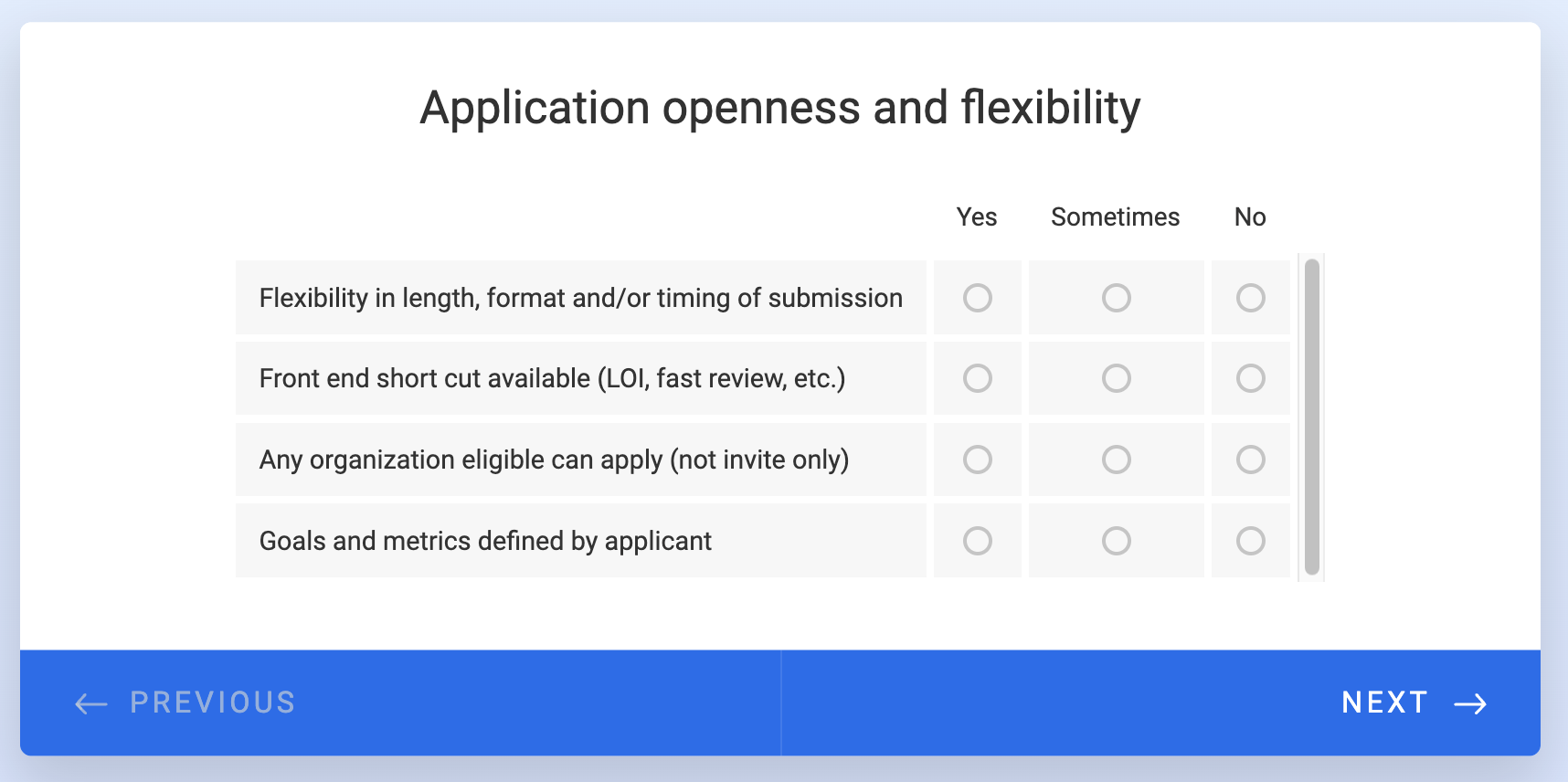
See What I Mean’s Grantmaker Openness Assessment will help you make equity-led improvements to your funding process.
1. Evaluate Your Default Settings
Our Grantmaker Openness Assessment is a self-evaluation tool based on equity in grantmaking best practices. This will give you a baseline to know how your organization is currently operating in areas like selection process transparency, application openness and flexibility, and applicant feedback.
2. Do the Homework
The Trust-Based Philanthropy Project (TBPP) encourages funders to take on the responsibility of researching prospective grantees in the early stages, saving them tons of time. As we say at SWIM, spend time with what’s already known.
3. Offer Multi-Year General Operating Support
SWIM consultant and experienced grantmaker Kerry McHugh recommends providing general operating support grants, committed in 3-4 year cycles. This increases your funded partners’ effectiveness and deepens trust with them over time.
4. Streamline Your Paperwork
Examine your application and report requirements with fresh eyes. What can you discuss in person rather than having it on an application? Can you approve renewal grants based on past reports rather than more paperwork? Can you operate on letters of inquiry before full proposals?
5. Ask for Feedback (and Implement It)
As TBPP says, philanthropy doesn’t have all the answers. Listen to your community to determine what changes need to be made to your application and reporting requirements, but don’t ask unless you plan to follow through.
6. Allow AI Use
In light of the chronic lack of dedicated grant writing staff at organizations that apply for grants, I am all for grant seekers using AI. It reduces the burden on them, helps them jump through hoops quicker, and allows them to apply for more grants than they’d be able to without AI support. If you can tell that a grant application used AI, consider if that may be what they had to do to be in the running.
7. Eliminate the Application Entirely
This is a bold move, but one that the Weissberg Foundation took in 2025 to provide surge funding for racial justice-focused grantees: “Many of our grantee partners are on the front lines and they don’t have the time or capacity to tell us all they need; and as funders, do we even need to hear it when we have evidence of the impacts of what is happening all around us?”
Consulting Services for Funders Ready for a Change
I know that funders face pressures for more accountability and reports and data, and I also know that they are mission driven. At See What I Mean, we want to call on grantmakers to consider who your system’s default setting might be weeding out, ignoring, mismatching, or even silencing…
And then make changes.
As philanthropy consultants, we can help you evaluate and update your application process to make it less burdensome and more equitable. Get a sense for our past philanthropy work in this Racial Equity Cohort Report, or set up a free 30-minute call with me if you’re ready to jump in.
Stacy Van Gorp, Ph.D. is a self-described organizational strategy and innovation geek. Stacy’s decades providing consulting services in strategic planning, innovation, research, and program design are rooted in her experiences leading a private foundation and her work in higher education, nonprofit leadership, fundraising and youth services. Her passion is helping leaders cut through complexity to illuminate opportunities. Her research interest centers around the role of trust in accelerating innovation. Stacy is recognized for her expertise in developing actionable models for change within institutions that serve a public good.
Her mission is to connect the people, resources, and ideas to change the world. See What I Mean is the manifestation of that mission.