
4 Areas We Prioritize at the Start of a Philanthropy Consulting Project: It All Comes Back to Trust
By: Kerry McHugh

In one of the very first proposals I wrote after joining the SWIM team as a consultant for philanthropic leaders, I wrote: “We believe that how a project starts is as important as how it finishes.” It hasn’t left my mind since. As I launch projects with incredible philanthropists, community foundations, and nonprofits, it becomes more and more true for me: The intentionality with which you start a project is just as important as how you carry it forward.
What I’ve learned at SWIM is that the proposal isn’t the beginning of a project. Neither is the contract or the scope of work. The relationship itself is the start – an idea that resonates deeply with my practice of the Equitable Evaluation Framework.
I’m newer to consulting, and my impression of this field in my previous role as VP of a private foundation was that it could often feel like a transactional relationship. That may be true of some consultants, but not the way we do it at SWIM.
We lead with trust-building and mutual partnership, and it results in more successful projects and long-lasting relationships.
Let’s look at how we “start” in four areas: conversations, onboarding, check-ins, and building trust.
1. How We Start the Conversation
We start with a clear client onboarding that includes surfacing assumptions in both directions.
I say my expectations out loud: “I understand this project to be one of facilitation and thought partnership,” or, “I’m assuming based on our scope of work that you’d like us to take this and run with it, checking in only occasionally for big questions before returning a draft back to you.”
We share what we already know – like immovable deadlines, who our main contact person will be, or a preference for in-person or virtual meetings. I ask about any gaps we need to fill – like existing documentation, upcoming board meetings, or how much time a client plans to spend in the project work itself.
Here’s the step that has surprised some clients (in a good way!). We share a spectrum of options for potential levels of engagement, with no right or wrong answers:
Are you looking for a thought partner?
Are you looking for someone to outsource to?
Are you looking for an outside expert?
Are you looking for someone to challenge you?
If you want a thought partner, for example, but you don’t have 20 minutes per week to check in, we might talk about how I could be the person you outsource to instead.
This approach is feeling more and more vital as I step into projects like community listening sessions, strategic planning, and board retreats, because every organization is radically different.
I have one project where all the stakeholders are volunteers. Being a thought partner to them looks different than it would look when working with the executive director of a community foundation – because context matters.
2. How We Start Onboarding
When we skip these conversations, we can think we’re on the same page without realizing, further down the road, that we were actually talking about different things. Without naming assumptions aloud, projects can fall down. Collective impact models can crumble. And stakeholders can sit frustrated as their needs aren’t met.
That’s why I like to begin my philanthropy consulting relationships with consistent clarity – because I mean to continue with that energy. How it feels to start work matters just as much as slides in a deck and terms in a contract.
I first saw how powerfully SWIM enacts this model during my onboarding to the company. They put thought and intention into orienting me to who SWIM is, the processes in place, the shared definitions I needed to know, the resources they wanted me to review, and the schedule for the first days and weeks.
I never had a feeling of, “I have no idea what I’m supposed to be doing.” It gave me confidence as I navigated a new role.
That type of “beginning” simply felt good, and I didn’t know exactly why. The dots have connected as I’ve continued down this path as a philanthropy consultant – the onboarding was designed to make me feel at ease and empowered. SWIM began as they meant to go on, and now I get to do the same.
3. How We Start Check-Ins

Shared Accountability is a model for engaging leaders across an organization to accomplish shared goals without needing a meeting for every decision.
In my expectation-setting with philanthropy advising clients, I also pull in elements from our Shared Accountability framework, which involves holding each stakeholder accountable to their portion of a project and running strategic group work meetings.
I apply this framework with my clients by giving regular updates on what I’m working on, even if I don’t have a deliverable ready yet. I ask for help if I need something from them, and we will collaborate right then and there in a working session.
It’s a refreshing change from the transactional status report updates I am used to in these types of spaces.
4. How We Start Building Trust
There’s a commonly held belief that trust and relationships will come from doing the work (it’s even a named orthodoxy in the Equitable Evaluation Framework). I want to challenge that belief, and the practices at SWIM support the idea that trust and relationships are the starting point for successful work, not just a byproduct of it.
My SWIM colleague Stacy Van Gorp, who has a Ph.D. in organizational trust, has a helpful framework for how trust is accelerated (or fractured) among collaborators.
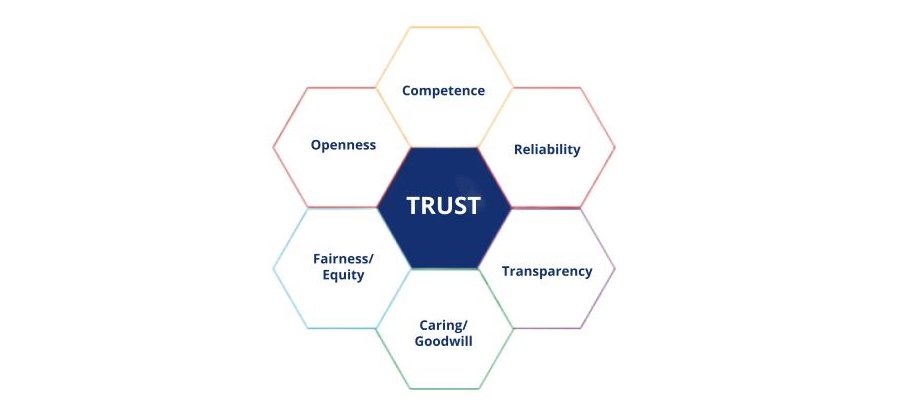
SWIM cofounder Stacy Van Gorp's research showed that strong organizational partnerships are built on six dimensions of trust.
Based on her research, trust is made up of six factors:
Competence: You are capable in this setting.
Reliability: You do what you say you’ll do.
Transparency: You provide me with a full and accurate picture.
Caring/goodwill: You are invested in my best interest, or don’t want to harm me.
Fairness/equity: You give me what others get or what I specifically need.
Openness: New information and what others need shift your actions.
Different engagements ask for different things depending on context. Some clients need to know that I am competent as their partner to do a large chunk of work without them. Others value transparency and want me to give them weekly updates.
I do my best to give folks room to name these expectations so we are on the same page. Stacy calls this “a down payment on trust.” From there, we draw on our “down payment” to foster continued trust as we grow in our working relationship. If there are any expectations that aren’t met in either direction, we have an easier time addressing and repairing the situation, because we talked about it up top.
Begin As You Mean to Go On
On a recent client onboarding call, a new client paused toward the end of the conversation and shared:
"You clearly have put a lot of thought into how to lead your clients and how to lead organizations."
Maybe that’s what happens when you put trust experts, philanthropic strategists, and relationship-driven community change activators in the same room. I felt it, our partners feel it, and it’s one of my favorite things about this work and the SWIM team.
The beginning is just as important as the end. Relationships are just as important as results. And change actually gets activated in lasting and meaningful ways when we move with intention to build those trusting relationships from the start.

Kerry McHugh is a Facilitator and Consultant at See What I Mean (SWIM). She has spent more than a decade in philanthropy as a foundation program officer, board member, and trustee, and has served as a Knowledge Curator for the Equitable Evaluation Initiative since 2021.