
Our AI Policy as Nonprofit and Philanthropy Consultants
By: Jordan Vernoy and Stacy Van Gorp, Ph.D.
We adopted AI relatively quickly at See What I Mean. We were eager to find ways that nonprofits and funders could use automation tools to make it easier to deliver on their mission.
We’ve led cohorts with food bank leaders in partnership with Remix Partners where we challenged them to pick an AI tool and use it for everything for 3 days, which led to 60 helpful use cases. We shared ways that grantmakers and grant seekers can use AI. And we offer consulting services for organizations who want to explore AI use while centering their own values.
Along with our enthusiasm comes a hefty dose of caution and intentionality. Since we talk about values-based AI so frequently, we wanted to offer a peek behind the curtain of what our internal AI policy looks like, along with some hesitations our team has had along the way.
Our AI policy has 10 central commitments, experimentation guidelines, bias checking rules, how we talk with clients about AI, questions we’re still wondering about, and more. It’s paired with a longer document about how we practice these policies.
We wanted to share part of our AI policy publicly - we love facilitating open conversations in the nonprofit and philanthropy space, so we’ll go first.
Plus, we’re giving away a guide on how philanthropy organizations can develop an AI policy that aligns with their ethics.
See What I Mean’s AI Use Policy
When it comes to AI use in our nonprofit and philanthropy consultancy, here’s the short version:
Use AI. Own your work. Protect client data. Tell us what you learn.
Here’s the long version, with 10 commitments we hold.
Our 10 Core Commitments
AI is a professional tool, used responsibly. We use AI to do better work for our clients. Staff are expected to use approved AI tools that we pay for in ways aligned with our goals and values.
Humans stay in the loop. No AI-generated work goes to a client without human review: we own every output, every decision, and every deliverable - AI doesn't.
We protect sensitive information. We use judgment about what we share with AI tools. We are especially careful with information that could harm someone if exposed: beneficiary data, personal struggles, immigration or legal status, mental health, financial hardship or details, or anything shared in confidence by people with less power.
We are transparent with clients. We discuss our use of AI with clients. We respect client policies and look for ways to align our practices.
We check our work for bias. We recognize that AI outputs may have biases. Before sharing AI-assisted analysis or recommendations, we ask questions like: Who might be harmed or left out? Whose perspective is missing? We apply additional scrutiny when work affects hiring, funding, or service decisions.
We use tools that align with our values. We evaluate AI tools for data privacy, ownership terms, and alignment with our commitments. We do not use tools that we cannot configure to prevent training on our data.
We respect intellectual property. We do not use AI to reproduce copyrighted material without authorization. We ask for and check citations and original sources.
We keep learning. AI is changing fast. We share what we learn, experiment thoughtfully, and update our practices as the field evolves.
We report problems. If something goes wrong - a data concern, an output that misses the mark, or a client issue - we address it promptly, honestly, and with accountability.
We look for ways to take action or responsibility on second-order effects. We’re thinking about what AI use means far beyond our walls and identifying actions we can take. For example, we are committed to maintaining entry-level and internship roles. AI will not be used to justify eliminating them. We stay mindful of the environmental costs of AI use and make individual and organizational choices to lower their footprint. We have a role in advocating for policies and regulations that protect communities and our natural resources.
Questions We Still Have
We remain curious about…a lot! Here’s a preview of what we’re asking ourselves:
What does team knowledge-sharing look like - format, cadence, who runs it?
What courses or certifications do we recommend or require?
What are peer organizations doing on AI policy?
What indigenous knowledge LLMs or alternative tools we should know about?
How do we estimate and offset our AI carbon footprint?
Our Team’s Reaction
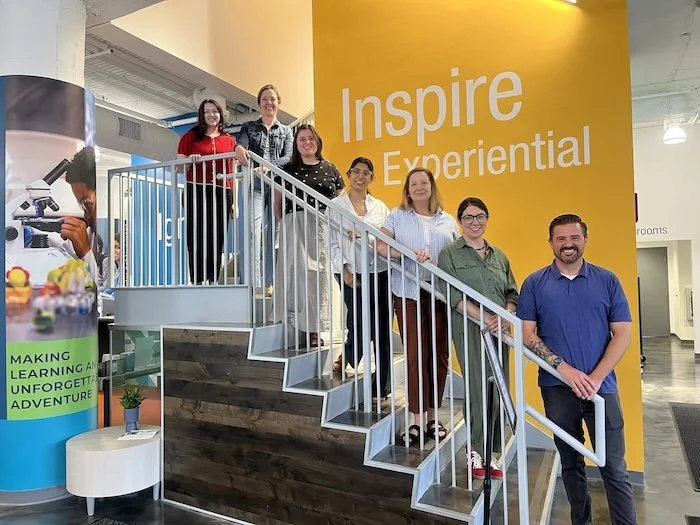
We have consultants on our team who had never touched an AI tool before coming to See What I Mean. So how did this land with everyone?
Here were some comments from our team when we discussed this policy for the first time - we asked them to share things they like, worry about, or wonder about:
“Just making it really clear how we are using AI, that transparency and openness feels right to me.”
“I've used AI before to help draft emails, which sometimes can speed you up. And then sometimes I think, ‘What tiny island is impacted by climate change? I can write my own.’”
“What are the implications and environmental cost in particular? I feel like we're only sort of beginning to understand that. That worries me.”
“I don't want to put out a deliverable with incorrect information.”
“When is it making it easier and when is it making it harder? Or when is it using a tool that actually doesn't need to be used?”
“[Using AI for coaching purposes] feels wrong. I don't have a better way to put it than - it just doesn't feel aligned with how I show up in those spaces.”
“I appreciated the distinction around intellectual property, that AI is a starting point and not a final product. I feel like I can now read things that someone has clearly put through AI and that is the product. And it lacks a humanity and it lacks nuance.”
We share this to show that AI use can come with hurdles. Open conversation was important to us so that we could embrace the hesitations, give everyone the space to share, and build a policy that worked with our team’s needs.
Our policy and its list of associated practices is a living document that will continue to be updated as we learn, and leaves room for questions and evolution.
Downloadable: Develop a Policy of Your Own
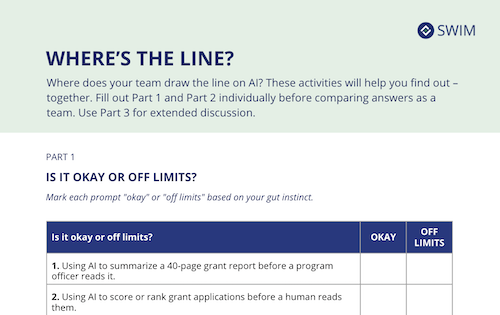
This PDF will give your team 12 real-world philanthropy scenarios (from summarizing grant reports to screening resumes) and three deeper case studies on when and how to disclose AI use. We included 19 questions for an extended discussion on these topics.
Run it in your next team meeting, compare notes, and see where you agree - and where you don't.
There’s no email required. This button will get you the guide:
Get Help Developing a Mission-Driven AI Strategy
At SWIM, we help nonprofits, funders, and mission-driven organizations with strategy and activating change. If you’re exploring how to incorporate AI in a way that’s practical, responsible, and grounded in purpose, we’d love to help.
See What I Mean offers:
AI cohorts: A structured working cohort and ongoing community for nonprofits and funders to explore AI in a mission-centered way.
AI training for organizations: Practical, values-based AI training designed for foundation and nonprofit teams. We focus on building the kind of understanding that goes beyond awareness, inviting people to change their workflows with intention and in ways that feel values-aligned.
AI planning: We help foundations and nonprofit leaders think through how AI fits - or doesn't - into their organization's strategy, operations, and values. The result is a shared internal framework like the one we shared in this article, owned by your team members and aligned with your organizational values.
AI use workshops: We design and facilitate workshops tailored to where your team actually is - building shared understanding, surfacing hard-to-name tensions, and creating space for the decisions that matter. Our facilitation is grounded in values and practical enough to move things forward.
Book a free 30-minute call with a SWIM team member today to explore the next step that might fit your context.